
Negotiating badly with a marketing agency costs more than standing still for a few months.
When a company picks the wrong agency, it rarely loses money all at once. The damage arrives disguised as routine: campaigns running with no criteria, a pretty report with no commercial impact, leads coming in unqualified, the sales team complaining about quality, and nobody able to say clearly where the ROI went.
That is the central point: a bad agency almost never looks like a mistake in month one. It looks like movement. And movement without direction is expensive.
The market got bigger. So did the risk of hiring badly.
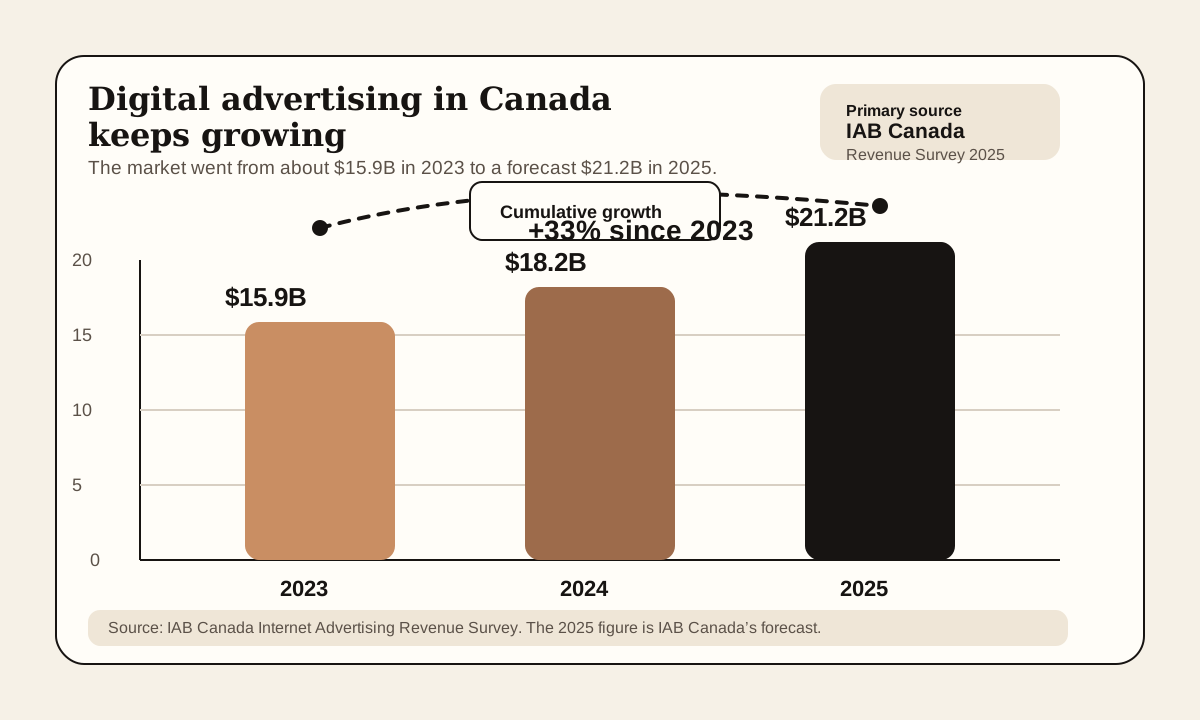
Canadian digital advertising reached $18.2 billion in 2024, up 16.6% over 2023, and IAB Canada forecasts $21.2 billion for 2025. There is more agency supply and more money moving through media than ever.
The problem is that a lot of companies still pick a marketing partner the wrong way:
- by the most "complete" scope
- by the lowest fee
- by the rush to start
- by the volume of deliverables
- by the flashiest portfolio, barely connected to their own context
When that happens, the company buys execution before buying a diagnosis. And it almost always pays twice: once to learn, once to correct.
The invisible cost of the wrong agency
The wrong agency does not just fail at creative. It amplifies whatever is already misaligned in the operation.
Manual handoffs between marketing and sales are still the norm at most companies, and a great deal of time gets lost to manual tasks, scattered data and poor funnel visibility.
That is why hiring an agency is not only a marketing decision. It is an operational one.
If the agency works isolated from sales, from the CRM, from attribution and from the business's real goals, it may well generate activity. What it does not necessarily generate is results.
In practice, the signs of waste tend to be these:
- more leads, but fewer sales
- more campaigns, but little clarity on CAC and ROI
- more status meetings, but fewer decisions
- more pieces delivered, but little accumulated learning
Execution agency vs. consultative agency
Every agency executes. The difference is what it does before executing.
An execution agency gets into production fast. It builds a calendar, launches campaigns, publishes creative, delivers a report and maintains the feeling of constant activity. In many cases that gets sold as agility. But without a diagnosis, agility only accelerates waste.
A consultative agency starts with questions that seem less glamorous but matter far more:
- What is the business goal?
- What is the real margin?
- What is the average ticket?
- How long does a lead take to become a sale?
- Where does the funnel stall today?
- Who is the actual buyer?
- Can the sales team absorb the demand?
If those questions do not show up in the sales process, you are probably buying production, not strategy.
That matters even more now. Nearly everyone in the market endorses integrating branding and performance; far fewer actually execute it. The industry already accepted the thesis. The problem is still aligned execution.
How to choose a marketing agency: 6 questions that protect your investment
If you are evaluating proposals right now, this is the filter that best protects cash and expectations.
1. How do you connect marketing to revenue?
If the answer comes back only with reach, leads, CPC or engagement, it is incomplete. The agency has to explain how it tracks qualification, conversion, CAC, pipeline and return.
2. Which accounts and access stay in my name?
Your company should hold access to the media accounts, analytics, tag manager, CRM, Search Console and automation. A serious agency does not build a black box.
3. What is the diagnosis before the plan?
Before proposing a campaign, the agency needs to understand your commercial model, your positioning, your margin and your bottlenecks. A proposal that arrives too fast usually means a generic package.
4. How do you measure success at 30, 60 and 90 days?
A good agency knows how to separate short, medium and long-term expectations. Not everything is an immediate sale, but nothing should be left without a criterion for progress.
5. How do you react when a campaign does not perform?
Every serious operation needs a response protocol: an analysis window, a hypothesis, a test, an adjustment and communication. The differentiator is not never being wrong. It is correcting fast and learning consistently.
6. How often do you review strategy, not just deliverables?
A monthly report on its own is not enough. What you want is a review cadence dealing with decisions, not just status updates.
Warning signs during negotiation
If you want to spot a bad agency before signing, watch for these:
- promises results without understanding your context
- talks a lot about vanity and little about operations
- avoids sharing platform access
- sells a "complete package" without detailing priorities
- does not ask about sales, margin, CRM or funnel
- outsources almost everything while selling itself as a senior operation
- treats media, content and sales as independent silos
None of these alone condemns an agency. But several of them together almost always predict frustration.
The most common mistake: hiring marketing without aligning sales
A lot of companies switch agencies when the real problem sits in the handoff between marketing and sales.
If the sales team does not know what the campaign promised, if the CRM does not record source consistently, if nobody tracks stage-to-stage progression, and if sales feedback never returns to media, the agency becomes the scapegoat for a systemic problem.
A good agency helps diagnose that. It does not just deliver leads. It helps organize the path that turns attention into opportunity and opportunity into revenue.
FAQ
How do I choose a digital marketing agency? Choose on the ability to connect strategy, media, content and sales to measurable goals. The best agency is not the one delivering the most volume, it is the one that shows how the work affects CAC, conversion and revenue.
What should I ask before hiring an agency? Ask how it measures ROI, which accounts stay in your name, how it runs a diagnosis, how it reacts to underperforming campaigns, and what the strategic review routine is.
Is it worth hiring the cheapest agency? Not always. A low fee can hide a junior operation, low seniority, little analysis and generic execution. Cheap gets expensive when the company loses months without real learning.
Do I need access to the media and analytics accounts? Yes. The client company should hold access to the accounts and digital assets. Without it, you lose transparency, autonomy and data history.
How do I know whether the agency is delivering results? You have to track business indicators, not just activity metrics. Leads, clicks and impressions matter, but the centre of the analysis should include qualification, conversion, CAC, pipeline and attributed revenue.
Conclusion
Choosing a marketing agency is not buying posts, media or design. It is choosing a partner to interfere directly in how your company grows.
If the hiring starts with price, it almost always ends in rework. If it starts with diagnosis, goal clarity, data access and accountability for results, the conversation changes level.
In the end, the right question is not "which agency delivers more things?". It is: which agency understands enough about my business to make marketing work in favour of revenue?
Read next
- Communications agency or marketing agency? What actually differs
- How much a marketing agency costs in Metro Vancouver
- GEO: how to get your brand cited by ChatGPT and Google AI in 2026
Sources and references
This is Koko's point of view on hiring marketing with less noise and more operational clarity.